Lessons from a Real Investment Loss About Risk Management | Investment Principles Learned from Failure #001
Every investor eventually faces the same difficult question:
Should I keep holding, or should I reduce my position?
What You’ll Learn in This Article
- Why position sizing matters more than finding the perfect selling price
- Three technical signals that suggested it was time to reduce risk
- How a simple partial exit could have changed the outcome
- Why protecting your capital is more important than protecting your ego
Would You Sell… or Wait?
Imagine your investment is down more than 20%.
Then the stock finally rebounds.
Would you sell part of your position?
Or would you wait until you break even?
I chose the second option.
I kept telling myself,
“Just a little higher… then I’ll sell.”
That decision became one of the most valuable investing lessons I’ve ever learned.
Most investors don’t lose money because they can’t pick good stocks.
They lose because they don’t know when to reduce risk.
This article analyzes my own trading experience and explains why position sizing may be one of the most underrated skills in investing.
Why Most Investors Fail at Position Sizing
Position sizing isn’t about selling everything.
Nor is it about holding forever.
It’s about adjusting your exposure as market conditions change.
Unfortunately, many investors become trapped by one dangerous emotion:
The Break-even Bias.
Instead of analyzing the market,
we begin negotiating with our emotions.
“I’ll sell once I get my money back.”
The market doesn’t know your entry price.
It only reacts to buyers and sellers.
Real Portfolio Example
(Insert portfolio screenshot here 실제 계좌 이미지 삽입 ])
Average Cost: 3,634 KRW
Shares Held: 552
Highest Rebound Price: Approximately 2,770 KRW
Looking back,
I wasn’t following the chart.
I wasn’t watching momentum.
I wasn’t measuring risk.
I was simply staring at my average purchase price.
That emotional attachment prevented me from making a rational decision.
Three Technical Signals I Ignored
Let’s compare the difference one small decision could have made.
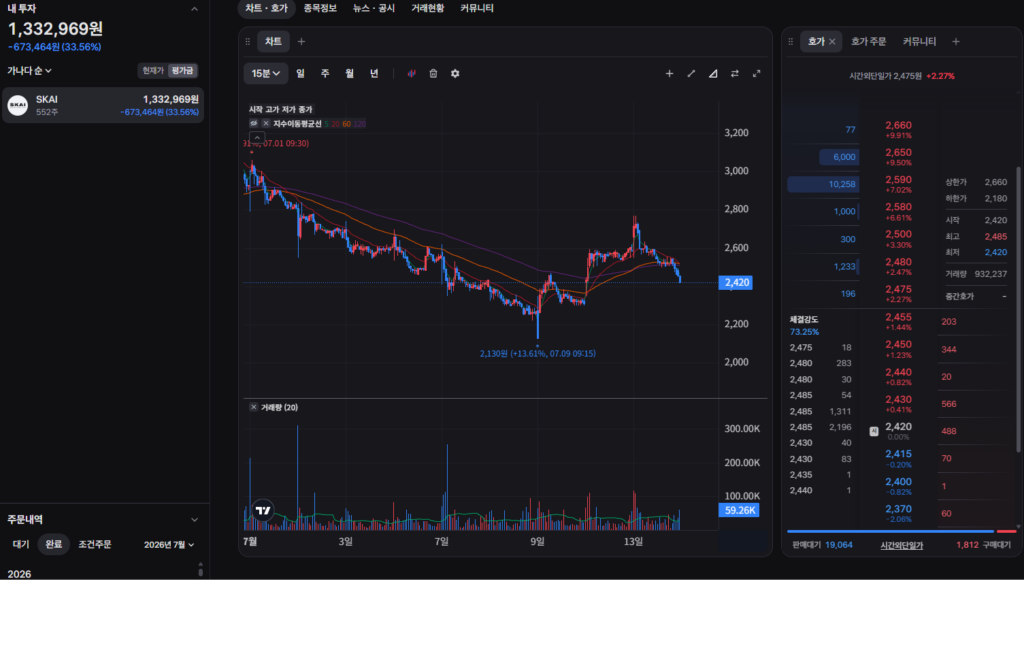
After reviewing the chart objectively, three signals stood out.
- Rising Volume with Weak Price Momentum
Trading volume increased,
but price failed to continue making strong advances.
This suggested that selling pressure might have been increasing.
- Price Was Approaching a Major Resistance Zone
The rebound reached an area where previous investors were likely waiting to sell.
Resistance zones often become natural places for profit-taking or risk reduction.
- No Clear Evidence of a Trend Reversal
A rebound is not the same as a new uptrend.
At that time,
there wasn’t enough evidence to conclude that the long-term trend had changed.
I allowed hope to replace objective analysis.
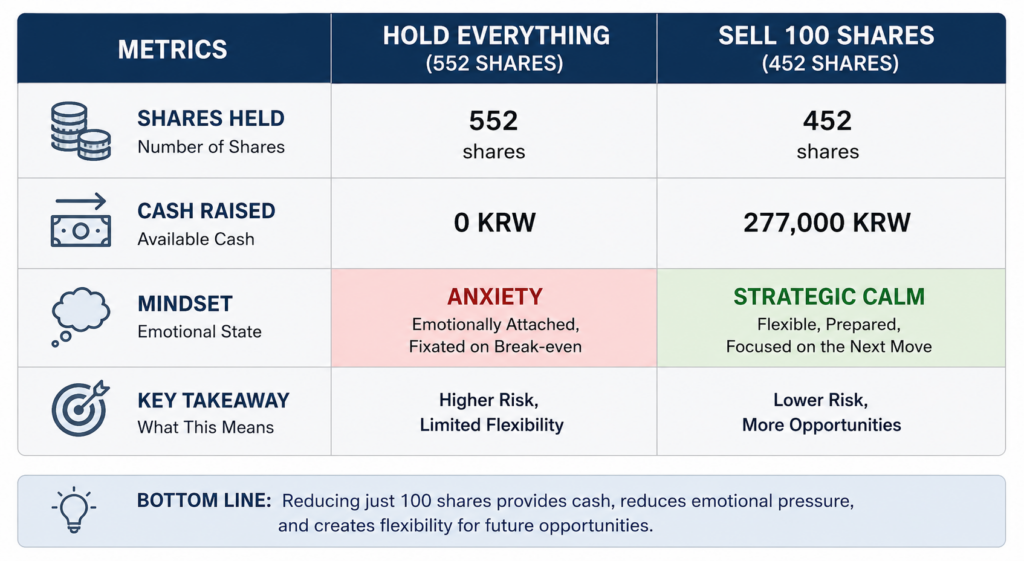
Notice something important.
This isn’t about selling everything.
It’s about creating options.
By reducing only part of the position,
I could have lowered emotional pressure,
secured cash,
and prepared for future opportunities.
Position sizing doesn’t guarantee higher profits.
It gives you more flexibility to protect your capital and seize future opportunities.
The Lesson That Changed My Investing
Today, I follow one simple investment principle.
A good exit isn’t about selling at the highest price.
It’s about reducing unnecessary risk.
Selling part of a position isn’t admitting defeat.
It’s giving yourself another chance to make better decisions later.
Key Takeaways
- Your average purchase price should never control your decisions.
- Position sizing helps reduce emotional trading.
- Partial selling creates flexibility for future opportunities.
- Capital preservation always comes before profit maximization.
Quick Self-Check
- Before making your next investment decision, ask yourself:
- Am I following the market or my emotions?
- Is this rebound supported by volume?
- Am I approaching a resistance level?
- Do I already have a position-sizing plan?
Next Episode
Investment Principles Learned from Failure #002
Why Investors Can’t Cut Their Losses
We’ll explore why the desire to “break even” often keeps investors trapped in losing positions far longer than they should.
Question for Readers
Have you ever held onto a losing position simply because you wanted to get your money back?
Did waiting help…
or make things worse?
Share your experience in the comments.
Investment Principles Learned from Failure
001 Position Sizing
Remember
- ✔ Don’t chase the perfect exit.
- ✔ Reduce risk before the market forces you to.
- ✔ Position sizing isn’t weakness. It’s one of the strongest forms of risk management.
It’s one of the strongest forms of risk management.
🇰🇷 한국어 요약
이번 글에서는 실제 투자 경험을 바탕으로 비중조절(Position Sizing) 의 중요성을 살펴보았습니다.
저는 평단가 3,634원, 552주를 보유한 상태에서 약 2,770원까지 반등했지만, “조금만 더 오르면 팔겠다”는 본전 심리 때문에 비중을 줄이지 못했습니다.
차트를 다시 분석해 보니,
- 거래량 증가에도 상승 탄력이 둔화되었고,
- 이전 매물대 저항에 접근했으며,
- 추세 전환을 확신할 근거는 부족했습니다.
만약 100주만이라도 매도했다면, 현금을 확보하고 다음 기회를 준비할 수 있었을 것입니다.
이번 경험을 통해 제가 얻은 가장 중요한 원칙은 다음과 같습니다.
좋은 매도는 최고가를 맞히는 것이 아니라, 리스크를 줄이는 것입니다.
Disclaimer
This article is based on my personal investing experience and is intended for educational purposes only.
It should not be considered financial or investment advice.
Always conduct your own research and consider your financial situation before making investment decisions.
Thank you for reading.
See you in Investment Principles Learned from Failure #002.