Why Volume Reveals What Price Can’t Tell You | Investment Principles Learned from Failure #003
What You’ll Learn in This Article
- Why price alone can be misleading
- What trading volume actually tells investors
- Three situations where volume matters most
- How volume can help reduce emotional decisions
Have You Ever Asked This Question?
The stock is moving higher.
But should you trust the rally?
Many investors focus only on price.
When the price rises, they assume demand is strong.
When the price falls, they assume the trend is over.
Unfortunately, the market isn’t that simple.
Price tells you what happened.
Volume often tells you why it happened.
Learning to read both together can help you avoid many emotional mistakes.
Why Trading Volume Matters
Every trade requires both a buyer and a seller.
Price shows the result.
Volume shows how much participation supported that result.
A strong rally with healthy volume often attracts broad market participation.
A rally with weak or declining volume deserves more caution.
Volume doesn’t predict the future.
But it helps investors judge the strength behind a move.
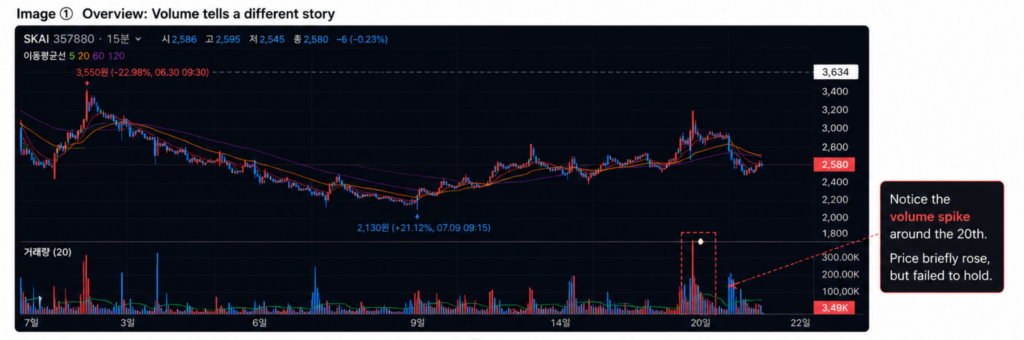
Three Situations Where Volume Matters Most
① Rising Price + Rising Volume
This combination often suggests that buyers are actively participating.
It doesn’t guarantee further gains,
but it generally provides stronger confirmation than price alone.
② Rising Price + Falling Volume
A rising price supported by shrinking volume may indicate weakening momentum.
Fewer participants are willing to buy at higher prices.
This doesn’t automatically mean the trend will reverse,
but it deserves closer attention.
③ Sharp Increase in Volume Near Resistance
Large volume near an important resistance area can signal that buyers and sellers are fighting for control.
Sometimes price breaks through.
Sometimes it fails.
Volume helps investors recognize that the market is reaching an important decision point.
Real Chart Example
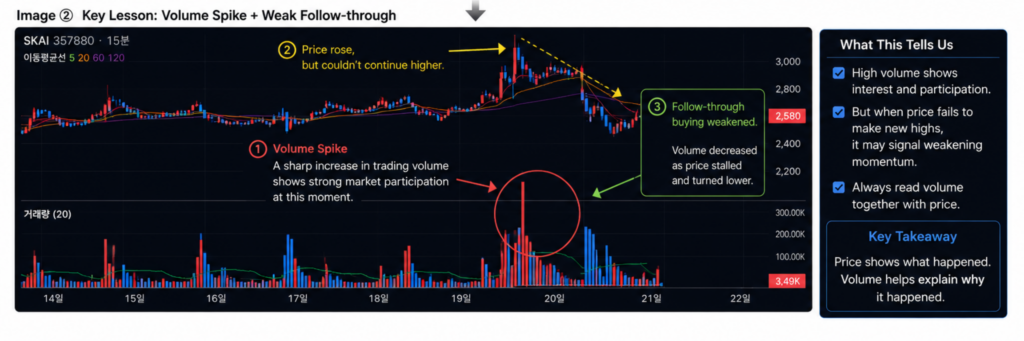
Looking back at my own investment,
I realized that I was watching only the price.
The rebound looked encouraging.
But volume was already suggesting that momentum was beginning to weaken.
Had I combined price and volume together,
I might have reduced risk much earlier.
One Principle That Changed My Investing
Price attracts attention.
Volume confirms conviction.
Today,
I never evaluate price without looking at trading volume.
Volume doesn’t eliminate uncertainty.
But it helps me make decisions based on evidence rather than emotion.
Quick Self-Check
Before your next trade, ask yourself:
□ Is volume supporting the price movement?
□ Is today’s volume higher than recent averages?
□ Am I buying because of evidence or excitement?
□ Would I make the same decision if volume were ignored?
Key Takeaways
✔ Price tells you what happened.
✔ Volume helps explain why it happened.
✔ Strong trends usually attract strong participation.
✔ Never analyze price without considering volume.
Next Episode
Investment Principles Learned from Failure #004
Why Averaging Down Feels Right—But Often Goes Wrong
We’ll explore why adding to a losing position can sometimes reduce risk—but can also become one of the most expensive psychological traps in investing.
🇰🇷 한국어 요약
이번 글에서는 거래량(Trading Volume)이 가격보다 먼저 시장의 힘을 보여줄 수 있다는 점을 살펴보았습니다.
많은 투자자는 가격만 보고 판단하지만, 가격은 결과를 보여줄 뿐입니다. 거래량은 그 움직임에 얼마나 많은 시장 참여자가 동의하고 있는지를 보여주는 중요한 단서입니다.
특히 다음 세 가지 상황은 반드시 함께 확인해야 합니다.
- 가격 상승 + 거래량 증가
- 가격 상승 + 거래량 감소
- 저항 구간에서 거래량 급증
이번 경험을 통해 제가 얻은 원칙은 하나입니다.
가격은 결과를 보여주고, 거래량은 그 결과의 신뢰도를 판단하는 중요한 단서를 제공합니다.
감정보다 근거를 바탕으로 투자하기 위해서는 항상 가격과 거래량을 함께 분석해야 합니다.
Disclaimer
This article is based on my personal investing experience and is intended for educational purposes only. It should not be considered financial or investment advice. Always conduct your own research before making investment decisions.